Introduction
With the increasing digitalisation of the events sector, event platforms have become an essential tool for event organisers. They offer a comprehensive range of features to facilitate registration management, enhance participant engagement, and analyse event performance in real-time.
But what exactly is an event platform, and how do you choose the one that best meets your needs?
What is an event platform?
An event platform is a software or web application that allows you to manage all stages of event organisation, from planning to closure. These technological solutions are used to centralise information, coordinate tasks, and improve communication with participants and speakers. In other words, they simplify the complex process of organising an event.
Why are event platforms essential for organisers?
Whether you are planning a conference, a corporate meeting, a trade show, or a general assembly, an event platform optimises the process by automating many repetitive tasks. This not only saves time but also enhances the participant experience and ensures the success of your event.
The best event platforms in 2026
When organising events, choosing the right platform is essential for ensuring smooth planning, engaging participant experiences, and simplified management. Whether you are organising a small seminar or a large trade show, here’s an overview of the best event platforms in 2026.
Imagina: An All-in-One platform for interactive events
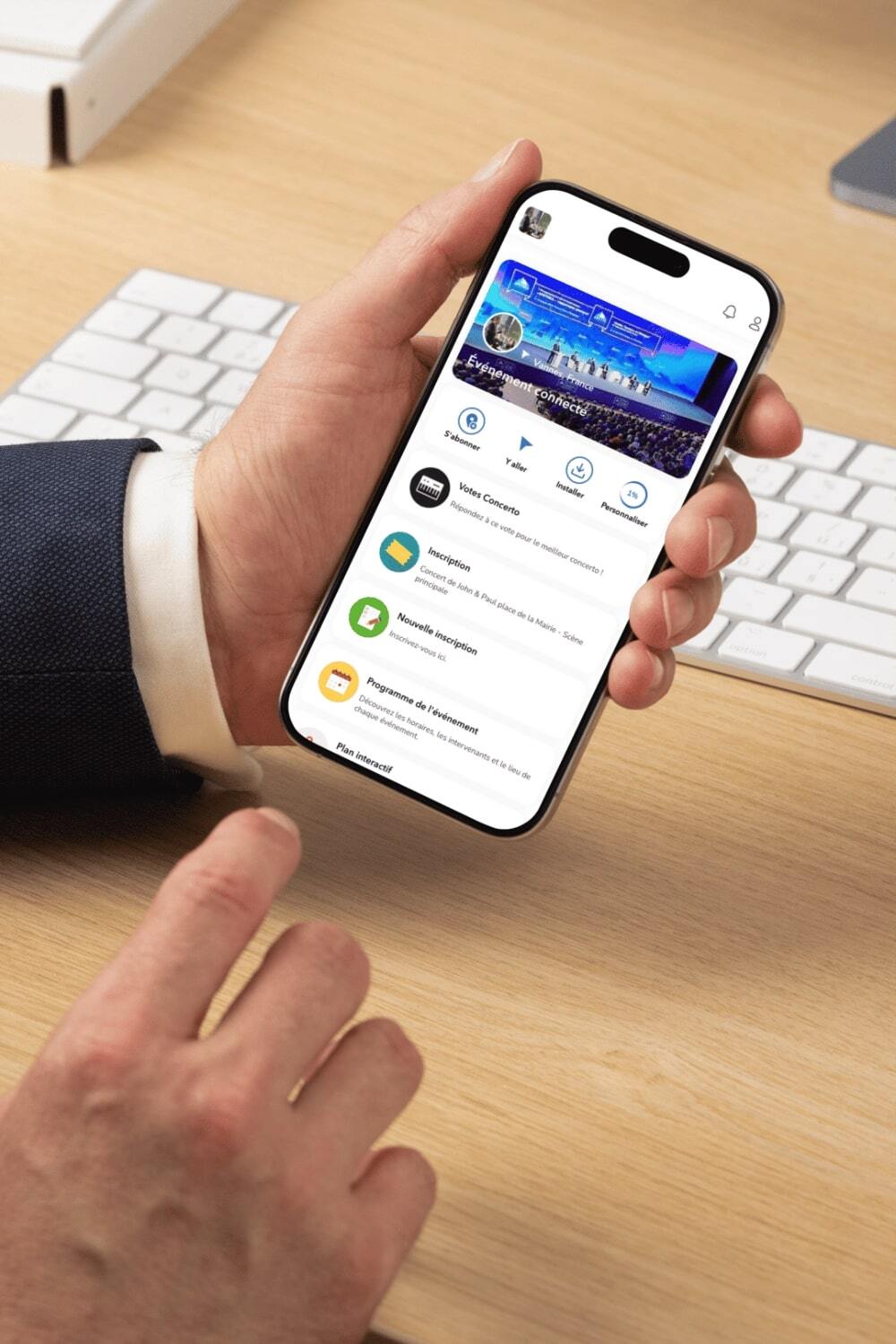
Imagina is a French solution particularly appreciated by event organisers for its ease of use and versatility. This event platform (mobile app or web app) stands out with its advanced features, allowing you to manage any type of event: conferences, general assemblies, trade shows, seminars, and even hybrid events. With an intuitive interface, Imagina provides a seamless experience for both organisers and participants.
Key features of Imagina:
Registration management
Imagina automates registration management through customisable forms integrated into your website or mobile app.
Simplified check-in
Using QR codes, welcoming and registering participants is quick and efficient.
Interactivity and engagement
To maximise engagement, Imagina offers tools for live polling, Q&A sessions, as well as networking features between participants and speakers.
With these tools, Imagina positions itself as a comprehensive solution for optimising events, whether in-person, virtual, or hybrid. Its competitive pricing makes it an attractive choice for SMEs, event organisers, and large companies seeking a flexible platform.

Demfati
Demfati is an innovative event platform that has developed across African and international markets. It provides a complete solution combining ticketing, marketing, and attendee management, with a strong focus on accessibility and digitalization. In 2026, Demfati stands out for its flexibility across various types of events.
Key strengths of Demfati:
Integrated ticketing
The platform simplifies online ticket sales and payment management.
Marketing tools
Demfati includes features to promote events and reach broader audiences.
Ease of use
Its intuitive interface allows quick onboarding for organizers.
Thanks to its flexible positioning, Demfati is an attractive option in emerging markets.
Xceed
Xceed is a European platform specialized in event management, particularly within nightlife and live event industries. It combines ticketing, CRM, and marketing tools to help organizers optimize sales and customer relationships. In 2026, Xceed is widely recognized in the entertainment ecosystem.
Key strengths of Xceed:
Advanced ticketing management
Xceed ensures smooth sales, access control, and attendee flow management.
Integrated CRM
The platform helps organizers better understand and retain their audience.
Revenue optimization tools
Features allow dynamic pricing and performance optimization.
Xceed is a strong solution for commercially driven events.
ON24
ON24 is a platform specialized in virtual events and webinars, mainly used for digital marketing and lead generation strategies. It is particularly popular among large enterprises for hosting high-value online events. In 2026, ON24 remains a leader in digital event marketing.
Key strengths of ON24:
Interactive webinars
The platform includes tools like chat, polls, and Q&A to engage remote audiences.
Lead generation
ON24 enables detailed prospect qualification through behavioral data.
Performance analytics
Detailed reporting helps measure event impact on marketing goals.
ON24 is a key solution for B2B digital marketing events.
Ayyah
Ayyah is a Swiss solution focused on event logistics management, particularly for equipment and operational resources. It helps organizers optimize planning and coordination. In 2026, Ayyah stands out for its operational efficiency approach.
Key strengths of Ayyah:
Equipment management
The platform tracks and organizes all event-related materials.
Logistics optimization
Ayyah improves coordination of teams and resources.
Operational efficiency
It reduces manual tasks and centralizes logistics processes.
Ayyah is an ideal complementary solution for logistics-heavy events.
Eventication
Eventication is a Belgian platform offering solutions for attendee management, accreditation, and event communication. It serves both corporate and public events. In 2026, Eventication stands out for simplifying organizational processes.
Key strengths of Eventication:
Accreditation management
The platform efficiently manages access and attendee profiles.
Centralized communication
Organizers can share real-time information.
User-friendly interface
Eventication offers a smooth and intuitive experience.
It is a practical solution for structured and secure events.
Fourwaves
Fourwaves is a Canadian platform specialized in scientific and academic conferences. It offers tools tailored to managing abstracts, speakers, and complex programs. In 2026, Fourwaves is a leading solution in the academic event sector.
Key strengths of Fourwaves:
Abstract management
The platform handles submission, review, and organization of scientific content.
Program management
It simplifies the creation of multi-session agendas.
Academic-focused experience
Designed specifically for researchers and institutions.
Fourwaves is particularly suited for specialized academic events.
|
Platform |
Positioning |
Strengths |
Limitations |
Market perspective |
|
Imagina |
All-in-one event platform |
Mobile app, interactivity, ticketing, networking, support |
Initial learning curve due to feature richness |
Cross-functional approach combining user experience, management and engagement |
|
Demfati |
Emerging markets / ticketing |
Accessible, simple, strong payment management |
Fewer advanced features |
Positioned around accessibility and progressive digitalization |
|
Xceed |
Nightlife / entertainment events |
Integrated CRM, revenue optimization, efficient ticketing |
Niche positioning (entertainment-focused) |
Strong specialization in commercially driven events |
|
ON24 |
Digital events / webinars |
Lead generation, powerful marketing tools |
Focused on virtual events only |
Strong orientation toward digital marketing and content strategies |
|
Ayyah |
Event logistics |
Equipment and resource management |
Not a full event platform |
Focused on operational and on-site logistics |
|
Eventication |
Attendee management / accreditation |
Simple interface, efficient access management |
Less interactivity and user experience |
Pragmatic solution for managing attendee flows and access control |
|
Fourwaves |
Academic conferences |
Abstract management, tailored to research events |
Highly specialized limited versatility |
Designed for specific academic use cases |
|
Cvent |
enterprise |
Comprehensive solution, advanced analytics, robust |
Complex to use, high cost, limited flexibility |
Historically designed for large organizations with structured needs |
The advantages of event platforms
Time and efficiency gains
By automating tasks, event platforms significantly reduce the time spent managing registrations, communications, and logistics.
Simplified event management
All important information is centralised on a single interface, facilitating real-time management.
Increased interactivity and participant engagement
Features such as live polls, interactive questionnaires, and online chats help to engage participants more actively.
The different features of event platforms
Event platforms offer a wide range of features. Among the most common are:
Registration management and check-in
Automate participant registrations and manage arrivals with QR code-based check-in systems.
Participant interaction
Encourage engagement with tools like polls, questionnaires, and live chats.
Real-Time event tracking and analysis
With interactive dashboards, you can track your event’s performance live and adjust elements accordingly.
What types of events can be managed via an event platform?
Event platforms can adapt to a wide variety of events, whether they are in-person, virtual, or hybrid. Here are some examples:
Corporate events
Meetings, training sessions, and general assemblies can be easily organised using an event platform.
Conferences and seminars
Participant and speaker management tools facilitate coordination.
Trade shows and exhibitions
Features like virtual booths and networking sessions are assets for this type of event.
Criteria to consider when choosing an event platform
When selecting an event platform, it is essential to consider several criteria to ensure it meets your specific event needs. The diversity of offerings in the market can make selection challenging, but by evaluating the following points, you can make an informed choice and guarantee the success of your project.
Cost and budget
Cost is often a determining factor when choosing a platform. The available solutions vary significantly in pricing, with some offering basic features at affordable prices, while others provide more advanced options at higher costs. It is important to define your budget before starting your search and ensure that the chosen platform offers good value for money based on your objectives.
Tips:
-
Compare several options before making a decision.
-
Don’t hesitate to request demos or free trials to assess whether the platform meets your expectations.
-
Check if the platform offers scalable plans to support your company’s growth.
Accessibility and user interface
The accessibility of an event platform is crucial for ensuring ease of use for both organisers and participants. A clear and intuitive interface allows for seamless navigation and efficient management of the various aspects of event organisation.
Points to check:
-
Is the platform user-friendly and easy to navigate?
-
Is it compatible with multiple devices (computer, tablet, smartphone)?
-
Does it offer responsive customer support in case of issues?
Planning and analytics features
Planning is one of the most important aspects of organising an event, and your platform should provide tools that allow for detailed real-time tracking of the process. Registration management, task tracking, communication with speakers, and post-event data analysis are key features to consider.
Tips for choosing wisely:
-
Ensure the platform provides a real-time reporting system.
-
Check if it offers automation tools to simplify the management of recurring tasks.
-
Can data be easily exported for in-depth analysis after the event?
Data security and ISO 27001 compliance
In a context where data security is critical, it is imperative that the platform you choose complies with current security standards, such as ISO 27001. This standard ensures that the platform has implemented rigorous practices to protect sensitive information from your participants and partners.
Questions to ask:
-
Is the platform compliant with security standards like ISO 27001?
-
What measures are in place to protect participants' data?
-
Does the platform offer advanced security options such as two-factor authentication?
Trends in event platforms in 2026
The event sector is constantly evolving, and platforms are rapidly adapting to new user expectations. In 2026, several trends are shaping event solutions, integrating cutting-edge technologies to enhance participant experience and simplify management for organisers.
Integration of artificial intelligence
Artificial intelligence is taking on an increasingly important role in event platforms. In 2026, AI solutions allow for analysing participant behaviours, adapting content in real-time, and automating repetitive tasks, such as managing registrations or sending reminder emails.
Examples of AI applications in events:
-
Analysing participant interactions to offer personalised content.
-
Automating marketing before and after the event, with targeted follow-ups.
-
Optimising live interactions with chatbots or virtual assistants.
Immersive experiences
In 2026, event platforms are adopting immersive technologies such as augmented reality (AR) and holograms to create more engaging experiences. These technologies enable organisers to create memorable events where participants can interact with content in innovative ways.
Examples of uses:
-
Using holograms for presentations during general assemblies.
-
Augmented reality for product demonstrations during trade shows or conferences.
-
Immersive experiences to foster interaction between participants and speakers.
Event marketing automation
Marketing automation is another major trend transforming how events are managed. With automation tools, it is possible to automate lead and prospect follow-up, send personalised emails before and after the event, and track participant interactions in real-time.
Examples of event marketing automation uses:
-
Automatically sending reminders for registrations and event updates.
-
Following up leads after the event with personalised email campaigns.
-
Automating the management of post-event surveys to gather feedback and improve future editions.
The importance of a mobile app in event management
A mobile app has become indispensable for providing a seamless and interactive experience for participants. It allows for real-time notifications, instant information sharing, and enhances engagement.
Conclusion
In summary, choosing the right event platform is a key factor in ensuring the success of your event. Whether for a small seminar or a large trade show, these technological tools will enhance your efficiency, improve participant experience, and deliver tangible results.
FAQ
What is the best platform for a small event?
Imagina is an excellent option for small events due to its simplicity and affordable cost.
How does an event platform enhance participant experience?
One of the greatest advantages of an event platform is how it enriches the participant experience. By providing a seamless and intuitive interface, it allows participants to easily access important information, interact with speakers, and actively engage in discussions.
How do event platforms facilitate the management of hybrid events?
Organising an event can be a daunting task, but with the rise of hybrid events, event platforms must allow for smooth management between in-person and virtual elements. Communication tools, streaming, and real-time interactivity are essential for ensuring a cohesive experience.
What are the key features to look for?
Registration management, real-time tracking, and participant interactivity are essential features.
How to choose the best platform based on your industry?
Needs vary by industry. B2B companies, for example, will prioritise platforms offering networking features, while B2C events will focus on public interactivity.
What is the average cost of an event platform?
Cost varies based on features and event size, but basic platforms start around €50 per month.


